Childrens Page

Verwood Museum Trust - Dorset UK. (Registered Charity No. 1067952)

Verwood Verwood 
History
Twinning 
Assoc
 
Verwood
What'sOn
 
VHHC
Exhibitions
Childrens
Page
Site Map  Ext
Links
 
Site
Search


Menu

Home


HOME MENU

Exhibitions Page
Childrens Page
Pottery Industry
About the Trust
VHHC History
Original State
Location
Coffee Shop
ForestFM @VHHC
Patrons
Trustees
Funding
Phase 2
Welcome
SITT @ VHHC 2006
SITT @ VHHC 2007


   Children's Page   


Page  Index

Children's Potting

Historical word search.

   Brief Description of Firing the Kiln at the Crossroads Pottery.   

Local Websites of interest to children (possible adults as well).


    REGULAR EVENTS for Children in Verwood    


   Frequency    time              Event                      Place        
Every Tuesday 10:30 a.m.
11:00 a.m.
RHYME Time
for under 2's and you.
Verwood Library
- contact 01202 822972
Every Friday  02:15 p.m.

Children's Story Time.

Verwood Library
- contact 01202 822972


      Children's Potting      


 Potting  at the Heritage Centre is currently suspended 
due to ill Health


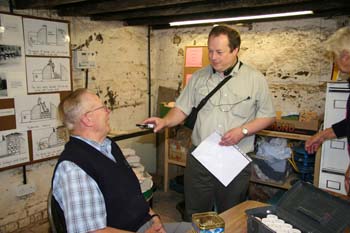
Hughie Green our resident potter being interviewed by Steve from "ForestFM"
Verwood's
Local Radio.

Potting is FREE for all those under the age of 19 years.

Please visit the Verwood "What's On" page for dates.
(Note:- that a refundable deposit is required on booking,
Refunds are made after the pot is glazed.)

For all  Activities it will be necessary to BOOK a slot 
by signing the book held in the Heritage Centre. 


Historical Word Search

O

E

D

L

Y

T

O

T

T

A

F

M

U

S

E

U

M

D

I

M

A

H

N

S

M

N

L

E

S

G

R

E

E

C

E

A

K

O

E

H

E

U

H

S

R

R

S

T

R

E

O

Y

V

L

O

S

R

D

C

S

I

I

D

A

F

E

E

T

Y

K

R

U

C

I

B

l

I

E

C

O

S

S

E

N

C

S

T

V

H

U

F

Y

D

B

D

E

N

R

F

E

T

I

V

C

M

N

A

M

T

D

W

E

M

Y

V

E

E

F

O

O

K

T

W

I

D

D

D

N

T

D

A

R

U

A

S

V

N

B

C

E

M

L

M

E

F

E

E

W

I

S

O

B

L

I

O

I

W

C

C

N

L

F

W

N

Y

C

S

B

C

E

B

L

W

L

I

D

T

L

E

D

M

K

W

T

C

A

A

C

W

I

I

A

U

E

E

F

I

C

H

B

U

I

I

U

S

D

R

C

O

A

S

T

F

G

H

U

K

C

A

D

O

K

L

N

S

E

E

B

N

I

I

F

D

V

C

W

C

N

K

F

S

V

N

I

G

B

S

C

V

O

E

T

B

T

H

I

C

S

R

C

D

R

Y

Y

T

L

E

C

N

A

S

S

I

A

N

E

R

V

R

W

Y

O

A

N

M

A

A

L

U

A

T

V

G

F

T

N

Y

W

E

Y

K

Y

M

W

H

A

R

K

V

A

G

R

M

T

C

Y

A

C

A

B

S

D

G

F

E

F

C

Y

D

C

K

D

G

T

S

R

M

R

G

E

U

R

U

C

F

G

H

I

T

O

V

E

B

O

O

K

R

D

M

Y

B

L

K

W

M

M

V

E

D

R

C

W

G

L

D

U

M

A

I

I

O

U

C

U

O

B

W

V

H

H

W

M

D

A

D

A

N

B

D

E

These are your words to search for!

MEDIEVAL

 FACT 

ALLIANCE

 MILITARY

 COIN

EVIDENCE

 BOOK

 IDEAS

 KING

DECADE

GREECE

 CENTURY

WARS

 REVOLUTION

 DATES

ERAS

 ANCIENT

 MUSEUM

 RESEARCH

RENAISSANCE


 Brief description of how the Kiln
 would work at the Crossroads Pottery.

(with thanks to Clive Daniels for the illustrations.)

The circular kiln was built in a large earth mound and the kiln chamber resembled a well made of bricks.   The firing chamber was under the well and had one fire mouth. The floor of the well was perforated to allow the flames through to the pots.
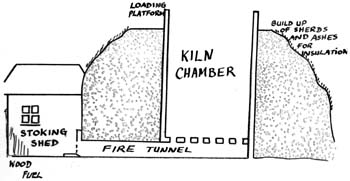
The original 15 feet diameter kiln was on the site of April Cottage situated to the west of the Heritage Centre.

The kiln was stacked from the top, the operator climbing down a ladder inside and receiving the pots from another operator outside. As the pots were usually glazed only on the inside, smaller ones could be stacked upside down inside larger ones.   Thus little kiln space was wasted. The pots were stacked on top of one another to the top of the kiln, which was then covered with sherds.
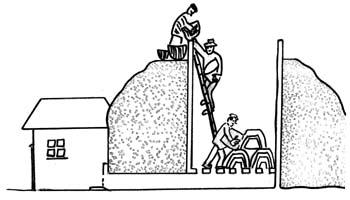
The kiln was first stacked from the top with smaller pots being placed inside larger ones.
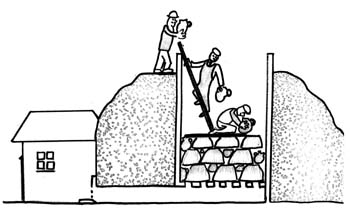
The skill was to systematically stack the kiln as shown.

The fuel used was wood, and firing took up to three days and nights beginning with a small fire and gradually building it up to get more heat. During this time the fire needed constant attention and towards the end of the firing faggots and gorse were put on to clear the fire and flux the glaze (flashing). 

No aids were used to determine the kiln temperature, this being determined-by the skill and experience- of the potter.   When the required temperature was reached certain bricks in the side of the kiln were watched carefully until they attained a recognised redness of heat, or until the sherds at the top of the kiln became coated yellow. One pot was then removed with a piece of iron with a hook on the. end, for testing.
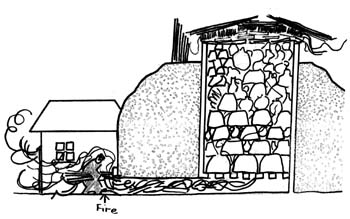
The kiln was wood fired and this firing took 2 days and 2 nights.
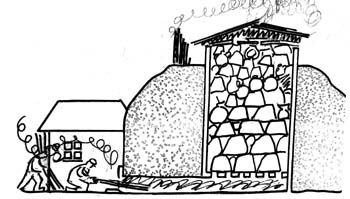
The third day was spent "burning off in order to 'flash' the glaze.

The kiln was then cooled gradually by blocking up the entrance to the firing chamber, leaving a very small hole. When the fire had been let out the kiln was left for two or three days to cool before it was emptied.


          Local Websites of Interest for Children          


GINGER POP

Enid Blyton, the author of "Noddy", "The Secret Seven" and "The Famous Five" amongst others, holidayed in Swanage and on the Isle of Purbeck in Dorset, three times a year for over twenty years and used local Dorset locations in her books. As an example Corfe Castle is the inspiration for Kirrin Castle in the Famous Five series of books.

Vivienne Endecott, a life long Enid Blyton fan, who runs this website, has written a book (The Dorset Days of Enid Blyton) and runs Theme Holidays and walks around Corfe Castle from her shop "Ginger Pop" in Corfe Castle square.

Why not visit her site at http://www.gingerpop.co.uk   which gives interesting local information about Enid Blyton.

SHOW ME

If you want something to do then why not try this fun site from UK's "Museums and Galleries".  
The "http://www.show.me.uk" site is a safe and non-commercial one for children,  produced by 24 Hour Museum, it is a collection of online games and interactive content from the UK's Museums and Galleries, for those aged 4 to 11.


In December on Christmas Eve WHY NOT TRACK SANTA.

For more than 50 years, NORAD and its predecessor, the Continental

Air Defence Command (CONAD) have tracked Santa.

Track him on his way round the World on the

evening of the 24th by visiting

http://www.noradsanta.org/en/default.php


Back Home Next

Send mail to with any questions or comments about this web site.                
For offers of help etc. then please contact :-  Miss Ann Page (Secretary)  on  +44 (0)1202 822658.               
Copyright © 2010 Verwood.org - Last modified: April 18, 2010